Showing posts with label ceos. Show all posts

Monday, May 4, 2015

Why CEOs Don't Want Executive Coaching


Getty
A recent study by the Stanford Business School found that nearly two-thirds of CEOs don't receive executive coaching or leadership development. And almost half of senior executives in general aren't receiving any, either. Paradoxically, nearly 100 percent said they would like coaching to enhance their development, as both Bloomberg BusinessWeek and Forbes reported in recent articles.

So, why do CEOs and other senior leaders say they want coaching but don't seek it?
I think the answer lies in what they've learned to think coaching provides, in contrast to what they think they need. Both views create a gap between desire and action. Ironically, that gap is unwittingly supported by most coaching programs, themselves. 

That is, most omit or misconstrue the core coaching element that CEOs need to grow their skills and effectiveness: Increased self-awareness, honest self-knowledge, about one's motives, personality capacities and values. The consequences of this absence play out in ways that diminish the relevance of coaching in the eyes of most senior leaders.

Self-awareness is crucial to leadership and it can be heightened through coaching. To explain why and how, consider the obvious but insufficient explanation for the paradox that CEOs want coaching but don't pursue it. Stephen Miles, CEO of the Miles Group, that partnered with Stanford on the study, pointed out that to CEOs, "coaching is somehow "remedial" as opposed to something that enhances high performance, similar to how an elite athlete uses a coach." Moreover, CEO's say they're most interested in such skills as conflict management and communication. Yet they put the need for compassion, relationship and persuasion skills far down on their list. They think of the latter as "soft skills," ancillary at best.

Both views reflect CEOs' perceptions. But those, in turn, reflect the failure of coaching programs to show that the infrastructure of successful leadership vision and behavior is heightened self-awareness about one's motives, values, and personality traits. That's especially true within today's challenging, fluid environment. Because of this failure, coaching programs unknowingly collude with CEOs' view that self-awareness is either irrelevant to leadership or of minor importance.

The higher up you go in companies, the more you're dealing with psychological and relational issues. Successful CEO leadership requires astuteness about others: their emotional and strategic personal drivers; their self-interest, overt and covert. These relationship competencies rest on a foundation of self-knowledge, self-awareness. And you can't know the truth about another without knowing it about yourself. 

Self-knowledge and the relational competencies they're linked with are central to a CEO's ability to formulate, articulate and lead a strategic vision for a motivated, energized organization. Self-knowledge builds clarity about objectives; it fine-tunes one's understanding the perspectives, values, aims and personality traits of others. When that's lacking, you often see discord and conflict among members of the senior management team; or between some of its members and the CEO.

Power and Empathy
Being able to see, understand and deal effectively with others' perspectives is key to successful leadership (as well as personal life). That capacity, part of self-awareness, is empathy. Two recent studies show its crucial role. One looked at the impact of power in an organization upon behavior; the other, its impact upon brain activity. Both studies found that increased power reduces empathy. 

One study, conducted by Adam D. Galinsky and colleagues at Northwestern's Kellogg School of Management, found that increased power tends to make one more self-centered and self-assured, but not in a good way: The researchers found that power makes one "prone to dismiss or, at the very least, misunderstand the viewpoints of those who lack authority." High-power individuals "anchor too heavily on their own perspectives and demonstrate a diminished ability to correctly perceive others' perspectives," according to Galinsky and his team, adding that, "As power increases, power-holders are more likely to assume that others' insights match their own."

The other recent study, by Canadian researchers, found the same thing by looking at brain activity when people have power. They found that increased power diminishes the ability to be empathic and compassionate because power appears to affect the "mirror system" of the brain, through which one is "wired" to experience what another person is experiencing. Researchers found that even the smallest bit of power shuts down that part of the brain and the ability to empathize with others.

These are highly important findings, because empathy, compassion and overall self-awareness are qualities of a developed, mature mind. One that's resilient to stress, able to manage internal conflicts, experiences interconnection with others, and maintains well-being. And, that therefore stimulates broad perspectives for understanding the problems and unpredictable challenges facing CEOs.

Much research shows that such capacities are essential personal strengths; certainly important to effective senior leadership. Moreover, studies find that you can grow them with conscious effort. The emotionally detached, un-empathic person, unaware of his or her personal motives or truths is not going to be very effective as a CEO or senior leader. We see examples of the consequences from time-to-time, when a CEO resigns or is fired. 

Building Self-Awareness
Self-awareness builds from honest self-appraisal about emotional strengths and vulnerabilities; your values and attitudes, personality traits and unresolved conflicts. You're a total person, not just a set of skills performing a role. 

One of Google's earliest executives, Chade-Meng Tan, teaches a popular course for Google employees that helps build such qualities. It's demonstrated positive benefits for success and wellbeing. And much research confirms that self-examination is critical for leaders' positive development. For example, Scott Keller, a director at McKinsey & Company, described the importance of overcoming self-interest and delusion in the Harvard Business Review. He emphasized the need for openness to personal growth and development, because "deep down, (leaders) do not believe that it is they who need to change..." and that "the real bottleneck...is knowing what to change at a personal level." Self-awareness also expands the capacity to know what not to pursue, not just what to go after, as Greg McKeown, CEO of THIS, Inc., described regarding what he learned from an Apple executive.

Coaching can provide several ways to enhance self-awareness. Here are a few I've found helpful to C-level and other senior executives.

Learn From Your Personal Time-Line: Describe key turning points in both your career and personal life, with an eye to what shaped your values, attitudes and behavior; how your career decisions and experiences have affected your personal development. Identify the consequences, both positive and negative. What does this knowledge point you towards, in terms of reclaiming and growing dormant or neglected parts of yourself?

The Capacities-Gap Exercise: List what you believe are your most positive personal strengths, qualities and personality capacities. Describe how each one has become stunted, blocked or deformed in their expression, in daily life. It happens to everyone. For each gap, describe what steps you could commit to taking, to enlarge those capacities and reduce the gaps in your role as a leader as well as in your overall life.

Identify Your Personal Vulnerabilities: All of us tend to develop a "cover story" along the course of our lives - what I called the narrower, "false" self in a previous post - beneath which is our "secret plot" - the real story, including our emotional blind spots, fears and pockets of dysfunctional behavior that can become hidden drivers of our lives. How can you rectify and grow through them?

Needless to say, effective leadership must also include necessary skills, vision and perspectives. For example, sustainable practices for long-term success, as business executive and sustainability thought-leader John Friedman regularly writes about, here.
Another is the movement towards joining business success with addressing social needs, as Richard Branson has described, where "taking care of people and the planet are at the very core of all businesses everywhere in the world." Adding that our current world of transparency and social media demands that "business reinvents itself and becomes a force for good in the world," he's leading a new effort in that direction, called The B Team.

Self-awareness and the growth it supports, combined with such business perspectives and practices, can and should be the heart of executive coaching and leadership programs.

Douglas LaBier, Ph.D., a business psychologist and psychotherapist, is director of the Center for Progressive Development in Washington, D.C. and writes the blog ProgressiveImpact.org. You may contact him at dlabier@CenterProgressive.org.

Friday, March 20, 2015

Measuring the Return on Character

When we hear about unethical executives whose careers and companies have gone down in flames, it’s sadly unsurprising. Hubris and greed have a way of catching up with people, who then lose the power and wealth they’ve so fervently pursued. But is the opposite also true? Do highly principled leaders and their organizations perform especially well?

F1504A_IW_LEADERSHIP

They do, according to a new study by KRW International, a Minneapolis-based leadership consultancy. The researchers found that CEOs whose employees gave them high marks for character had an average return on assets of 9.35% over a two-year period. That’s nearly five times as much as what those with low character ratings had; their ROA averaged only 1.93%.

Character is a subjective trait that might seem to defy quantification. To measure it, KRW cofounder Fred Kiel and his colleagues began by sifting through the anthropologist Donald Brown’s classic inventory of about 500 behaviors and characteristics that are recognized and displayed in all human societies. Drawing on that list, they identified four moral principles—integrity, responsibility, forgiveness, and compassion—as universal. Then they sent anonymous surveys to employees at 84 U.S. companies and nonprofits, asking, among other things, how consistently their CEOs and management teams embodied the four principles. They also interviewed many of the executives and analyzed the organizations’ financial results. When financial data was unavailable, leaders’ results were excluded.

At one end of the spectrum are the 10 executives Kiel calls “virtuoso CEOs”—those whose employees gave them and their management teams high ratings on all four principles. People reported that these leaders frequently engaged in behaviors that reveal strong character—for instance, standing up for what’s right, expressing concern for the common good, letting go of mistakes (their own and others’), and showing empathy. Examples include Dale Larson, who took over his family’s storm door business decades ago after his father died of cancer, growing it from about 30 employees to more than 1,500 and gaining a market share of 55%; Sally Jewell, a former CEO of REI, America’s largest outdoor retailer; and Charles Sorenson, a surgeon who moved into management at Intermountain Healthcare when the company began to grow and eventually took on the top job.

 “I’m Suspicious If a Report Card Is Too Good” 

Charles Sorenson, the president and CEO of Intermountain Healthcare, was one of the highest-scoring leaders in KRW’s study on character. He spoke with HBR about what he learned from the results. Edited excerpts follow.
At the other end of the spectrum, the 10 lowest scorers—Kiel calls them “self-focused CEOs”—were often described as warping the truth for personal gain and caring mostly about themselves and their own financial security, no matter the cost to others. This group includes the CEO of a public high-tech manufacturing firm, the CEO of a global NGO, and an entrepreneur who heads a professional services firm. (All study participants were guaranteed anonymity from the beginning. Only a third later gave permission to use their names.) Employees said that the self-focused CEOs told the truth “slightly more than half the time,” couldn’t be trusted to keep promises, often passed off blame to others, frequently punished well-intentioned people for making mistakes, and were especially bad at caring for people.

Early in the project the researchers expected to find a relatively small relationship between strength of character and business performance. “I was unprepared to discover how robust the connection really is,” Kiel says. In addition to outperforming the self-focused CEOs on financial metrics, the virtuosos received higher employee ratings for vision and strategy, focus, accountability, and executive team character.

Do leaders who need to work on their character know it? In most cases, no—they’re pretty deluded. When asked to rate themselves on the four moral principles, the self-focused CEOs gave themselves much higher marks than their employees did. (The CEOs who got high ratings from employees actually gave themselves slightly lower scores—a sign of their humility and further evidence of strong character.) Fortunately, Kiel points out, leaders can increase their self-awareness through objective feedback from the people they live and work with. But they have to be receptive to that feedback, and those with the biggest character deficiencies tend to be in denial.

How can such leaders get past their denial and overcome their character deficits? Seeking guidance from trusted mentors and advisers helps a great deal, Kiel says. He discovered that firsthand early in his own career. After earning a PhD in psychology, he built two large clinical practices and briefly served as the CEO of a publicly held company. Back then, he says, he was more like the self-focused CEOs than the virtuosos: “While I never engaged in any illegal behavior, I’m sure many of my colleagues in those days felt that I was more than willing to throw them under the bus if it meant success for me.” As Kiel reached middle age, though, he began to feel a sense of moral and spiritual emptiness—and he knew he needed to change. It was a long, difficult process. After all, he was trying to undo deeply ingrained habits. But with practice and counsel he succeeded, and he was inspired to help other business leaders do the same.

If Kiel’s experience (and his clients’) is any indication, character isn’t just something you’re born with. You can cultivate it and continue to hone it as you lead, act, and decide. The people who work for you will benefit from the tone you set. And now there’s evidence that your company will too.

Learn more about KRW’s findings in Return on Character, by Fred Kiel (Harvard Business Review Press, 2015).

Monday, February 2, 2015

“Lonely at the Top” Resonates for Most CEOs

Nearly two-thirds of CEOs do not receive outside leadership advice, but nearly all want it.
Man standing in front of office window overlooking Manhattan
CEO talking to employee
Nearly 100% of CEOs surveyed say they enjoy receiving coaching and leadership advice. (Getty Images)
"It's lonely at the top" appears to be truer than ever, according to a new study conducted by the Center for Leadership Development and Research (CLDR) at Stanford Graduate School of Business, Stanford University's Rock Center for Corporate Governance, and The Miles Group. Nearly two-thirds of CEOs do not receive coaching or leadership advice from outside consultants or coaches, and almost half of senior executives are not receiving any either, the survey reveals.

"What's interesting is that nearly 100% of CEOs in the survey responded that they actually enjoy the process of receiving coaching and leadership advice, so there is real opportunity for companies to fill in that gap," says David F. Larcker, who led the research team and is James Irvin Miller Professor of Accounting and Morgan Stanley Director of CLDR at Stanford GSB.

"Given how vitally important it is for the CEO to be getting the best possible counsel, independent of their board, in order to maintain the health of the corporation, it's concerning that so many of them are 'going it alone,'" says Stephen Miles, CEO of The Miles Group. "Even the best-of-the-best CEOs have their blind spots and can dramatically improve their performance with an outside perspective weighing in."

More than 200 CEOs, board directors, and senior executives of North American public and private companies were polled in the 2013 Executive Coaching Survey that Stanford University and The Miles Group conducted this spring. The research studied what kind of leadership advice CEOs and their top executives are — and aren't — receiving, and the skills that are being targeted for improvement.

Key findings from the survey include: 

Shortage of Advice Exists at the Top
Nearly 66% of CEOs do not receive coaching or leadership advice from outside consultants or coaches, while 100% of them stated that they are receptive to making changes based on feedback. Nearly 80% of directors said that their CEO is receptive to coaching. "If CEOs are willing to be coached and make changes based on coaching, it stands to reason that companies and boards should make this happen," says Professor Larcker. 

CEOs are Looking to be Coached
When asked "Whose decision was it for you to receive coaching?" 78% of CEOs said it was their own idea. Twenty-one percent said that coaching was the board chairman's idea. Miles sees this as a positive trend: "Becoming CEO doesn't mean that you suddenly have all the answers, and these top executives realize that there is room for growth for everyone. We are moving away from coaching being perceived as 'remedial' to where it should be: something that improves performance, similar to how elite athletes use a coach." 

Coaching "Progress" is Largely Kept Private
More than 60% of CEOs responded that the progress they are making in their coaching sessions is kept between themselves and their coach; only a third said that this information is shared with the board of directors. "As coaching is starting to lose its stigma, more of this secrecy is being removed," says Miles. "Although much of the coaching discussion should be treated confidentially," Professor Larcker adds, "keeping the board informed of progress can improve CEO/board relations." 

How to Handle Conflict Ranks as Highest Area of Concern for CEOs
When asked which is the biggest area for their own personal development, nearly 43% of CEOs rated "conflict management skills" the highest. "How to manage effectively through conflict is clearly one of the top priorities for CEOs, as they are juggling multiple constituencies every day," says Miles. "When you are in the CEO role, most things that come to your desk only get there because there is a difficult decision to be made — which often has some level of conflict associated with it. Stakeholder overload is a real burden for today's CEO, who must deftly learn how to negotiate often conflicting agendas. 

Boards are Eager for CEOs to Improve Talent Development
The top two areas board directors say their CEOs need to work on are mentoring skills/developing internal talent and sharing leadership and delegation skills. "The high ranking of these areas among board respondents shows a real recognition of the importance of the talent bench," says Professor Larcker. "Boards are placing a keener focus on succession planning and development, and are challenging their CEOs to keep this front and center. However, there is still a long way to go in the area of succession planning for most companies, especially as you get further down the reporting structure." 

Top Areas That CEOs Use Coaching to Improve
  • Sharing leadership/delegation
  • Conflict management
  • Team building
  • Mentoring
Bottom of the list:
  • Motivational skills
  • Compassion/empathy
  • Persuasion skills
"A lot of people steer away from coaching some of the less tangible skills because they are uncomfortable with touching on these areas or really don't have the capability to do it," says Miles. "These skills are more nuanced and actually more difficult to coach because many people are more sensitive about these areas. However, when combined with the 'harder' skills, improving a CEO's ability to motivate and inspire can really make a difference in his or her overall effectiveness."


Stanford University's Rock Center for Corporate Governance and Miles have collaborated on several research studies of CEOs and board directors, including the recent 2013 Survey on CEO Performance Evaluations, the 2011 Corporate Board of Directors Survey, and the 2010 Survey on CEO Succession Planning.

Monday, December 1, 2014

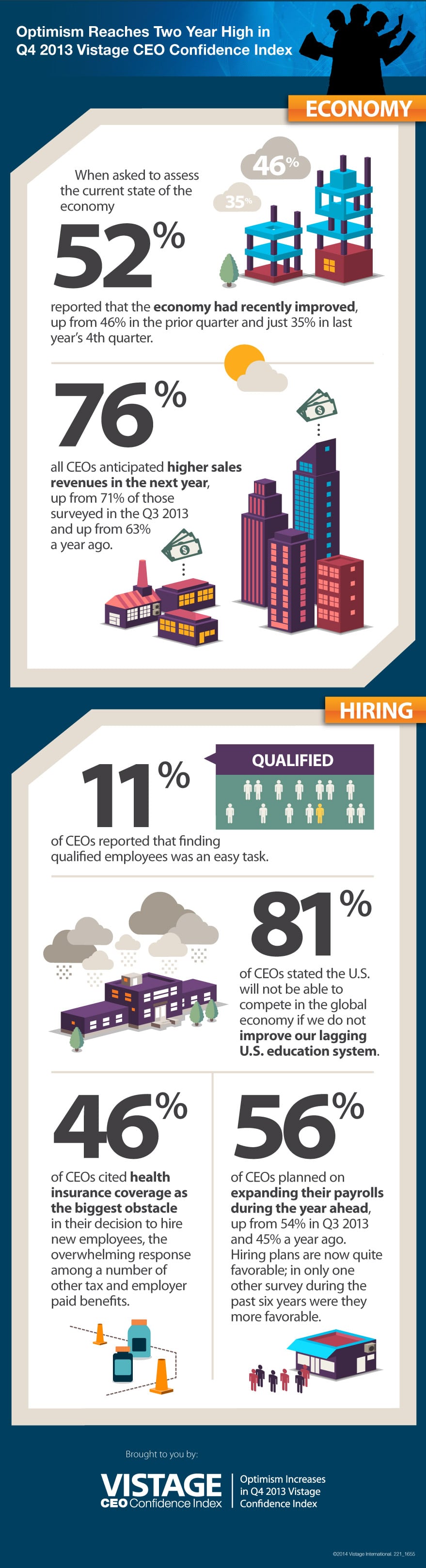
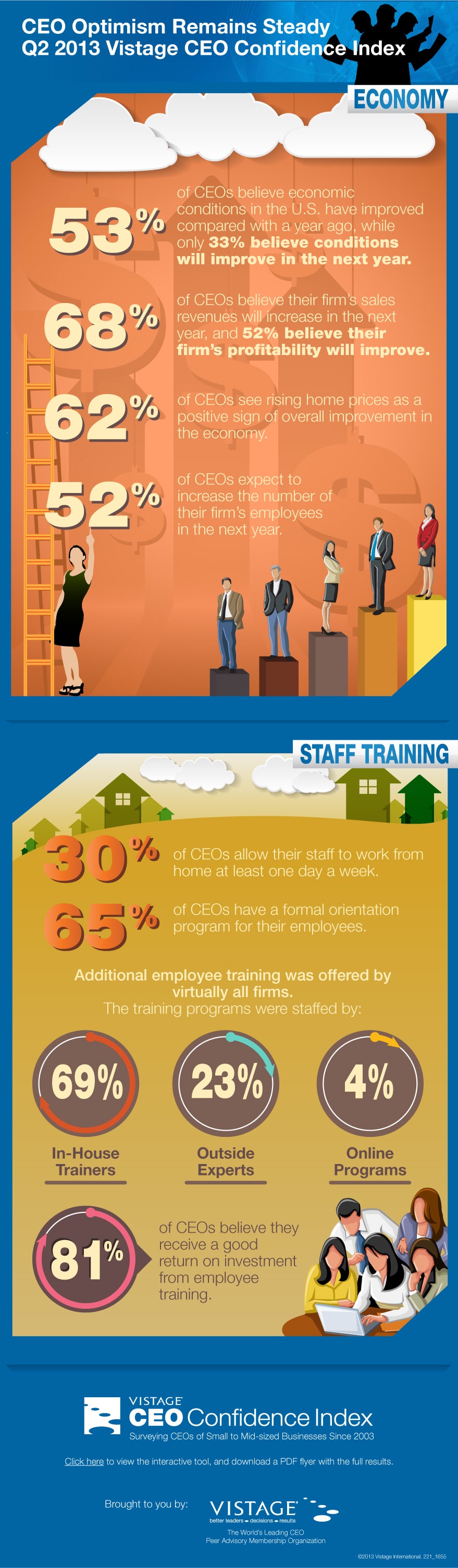
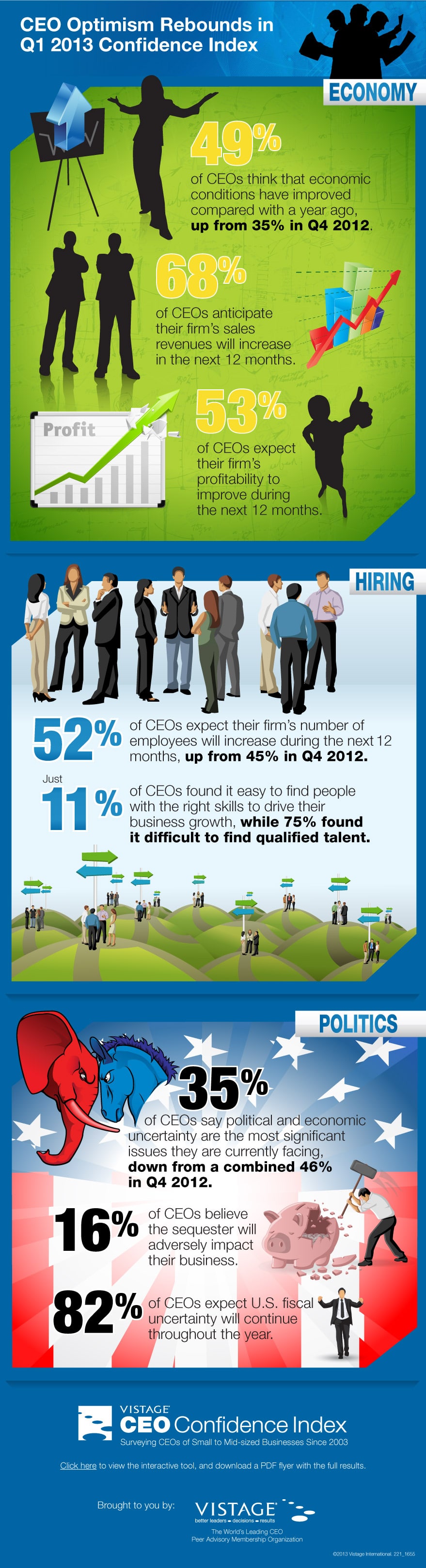
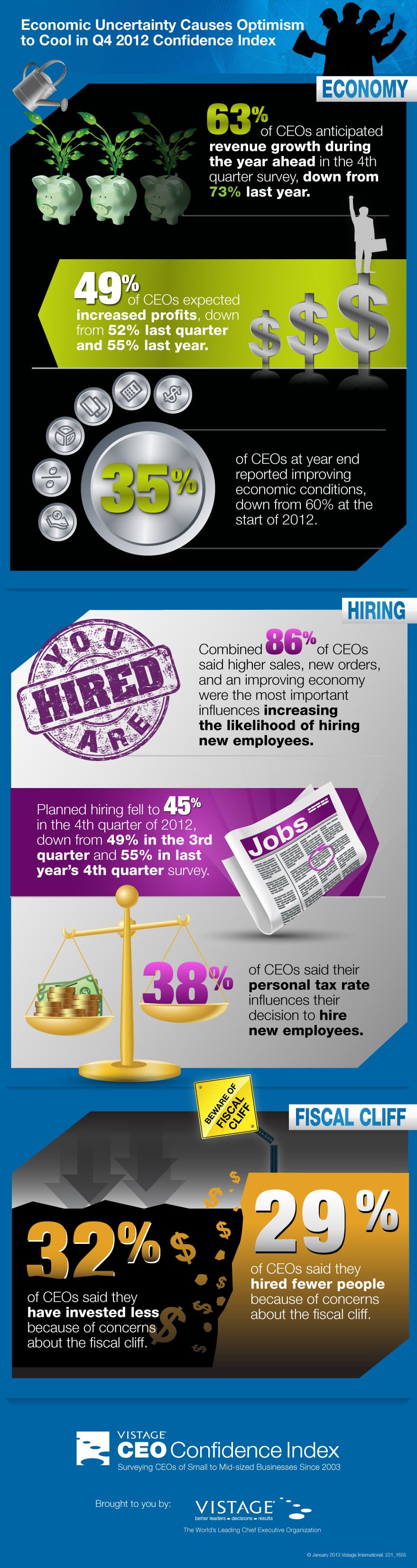
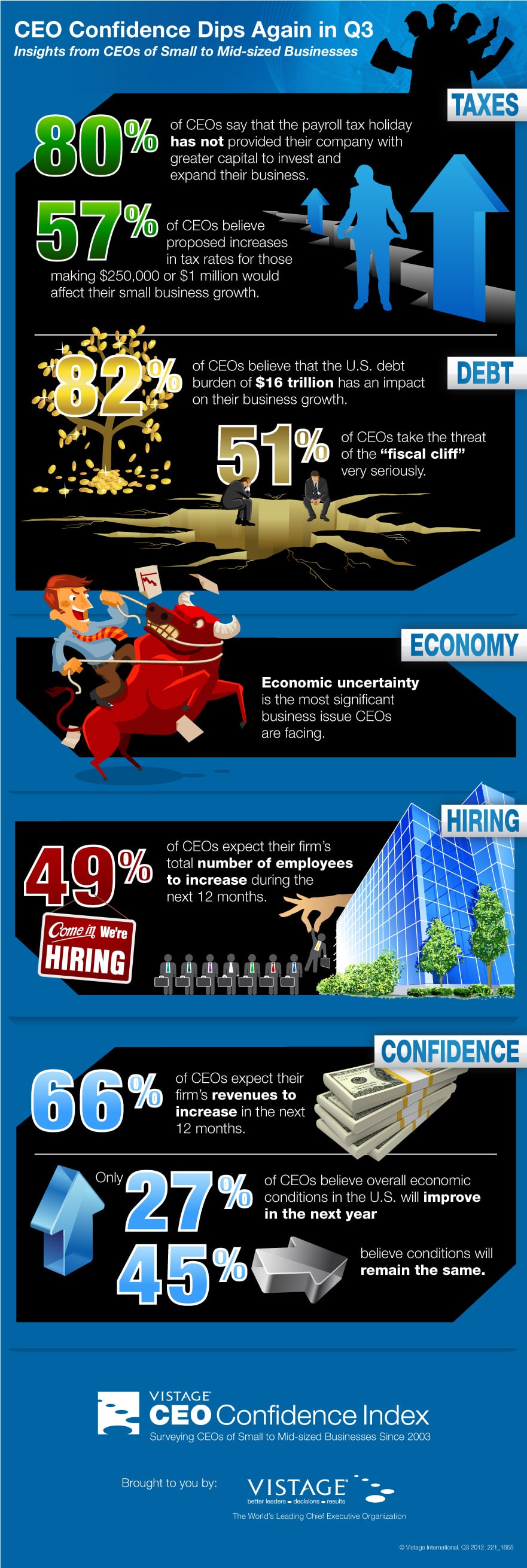
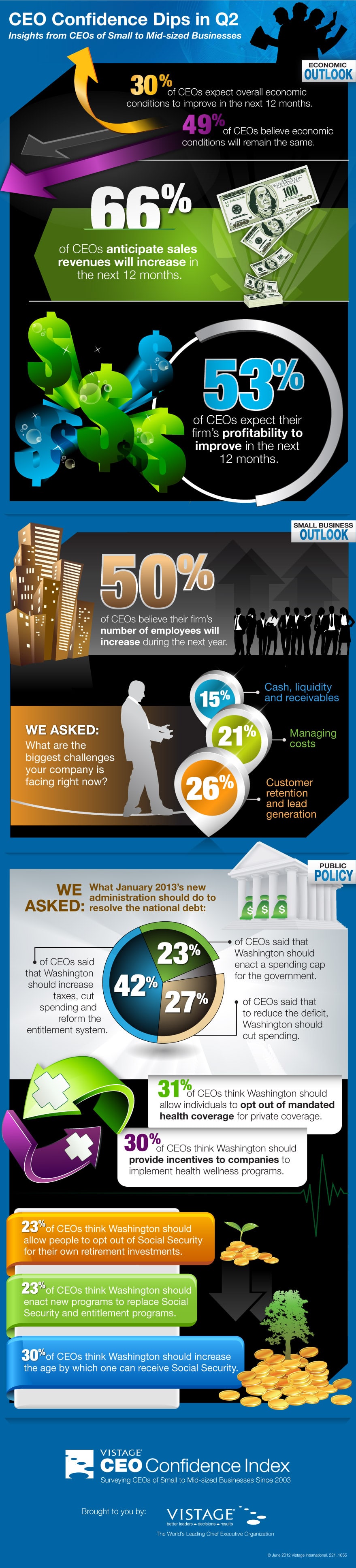
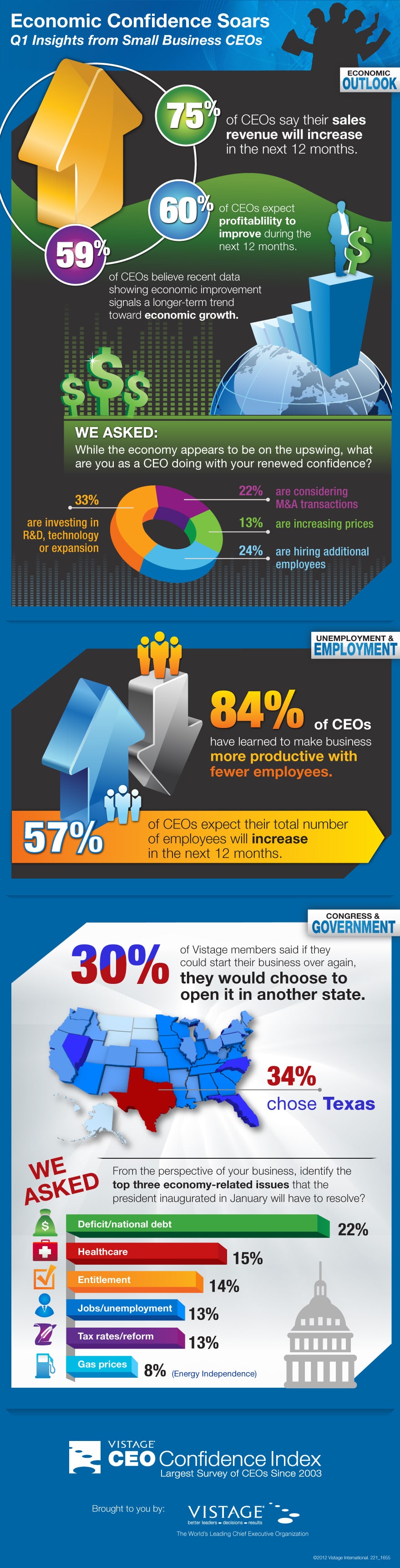
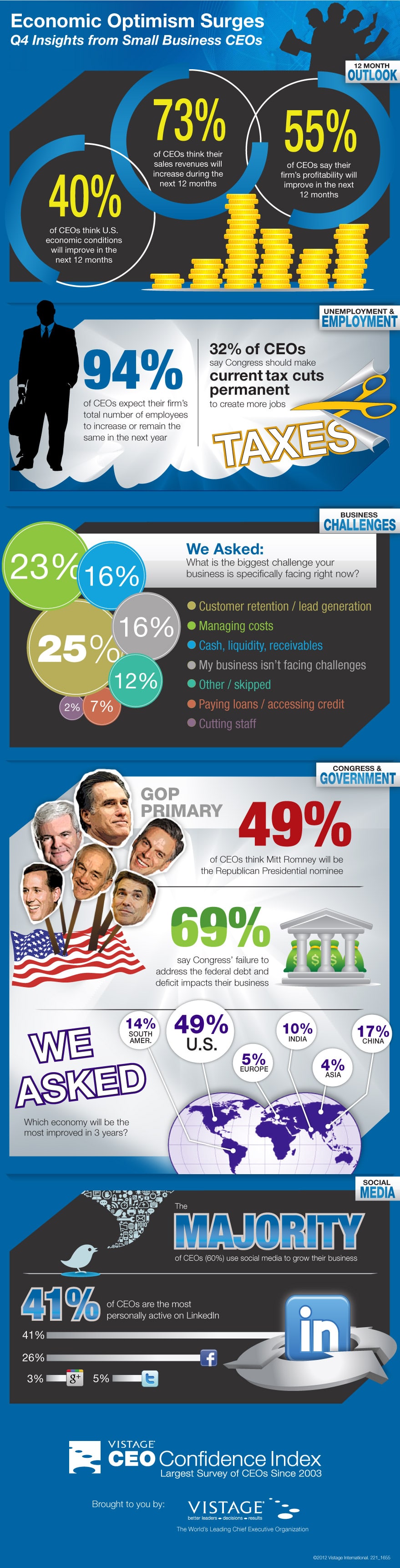
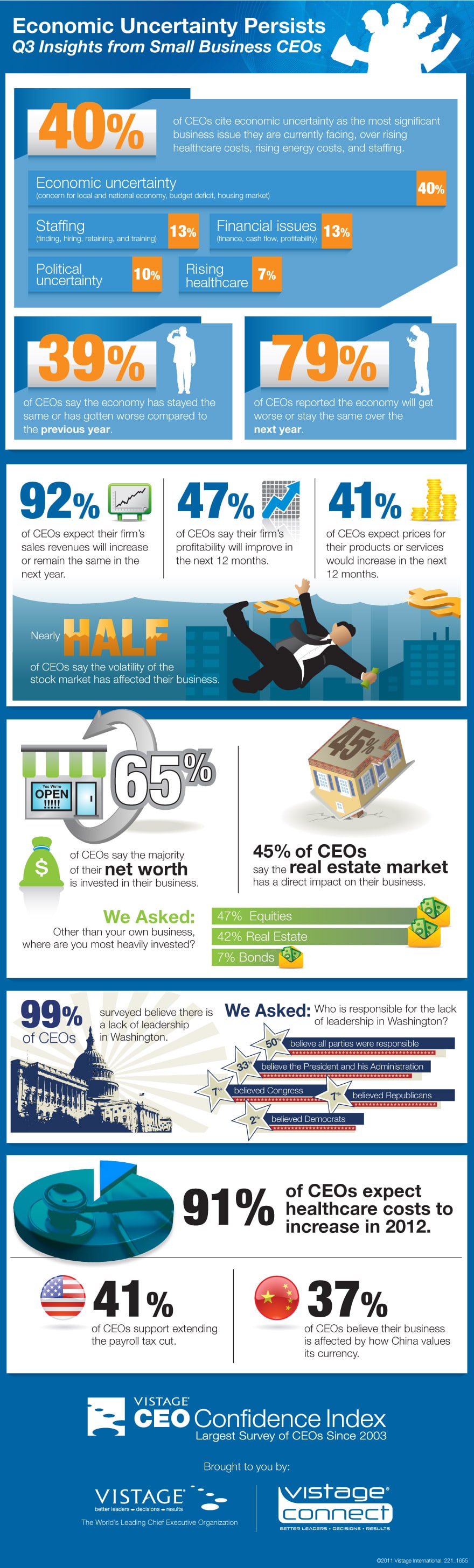
Vistage CEO Confidence Index - Optimism at a Two Year High among Small and Mid-sized CEOs

Vistage CEO Confidence Index

Optimism at a Two Year High among Small and Mid-sized CEOs, According to New Survey from Vistage

CI-graph-q3-280

SAN DIEGO (October 1, 2014) – Optimism among small and mid-sized business leaders is at a reported two year high, according to the Vistage CEO Confidence Index, the largest survey of chief executives from small and medium-sized businesses in the United States. And this vote of confidence from these business leaders reveals a positive trend in the U.S. economy as a whole. 

The Voice of Main Street Business

History
The Vistage CEO Confidence Index is a compilation of responses from more than 2,000 CEOs of small- to mid-sized companies. The Vistage CEO Confidence Index began in Q1 2003 and is the largest and only comprehensive report of small and mid-size CEO opinions and projections.

U.S. small and mid-sized businesses represent the most vital component of the nation’s economy. This sector creates 75% of all new jobs and generates 50% of all national revenue. The opinions of these business leaders provide a clear snapshot of current economic, market and industry trends and demonstrate their plans for growth over the next 12 months. These insights provide a leading indicator for employment, capital expenditure, sales, and revenue and profit trends.

When It Began
The Vistage CEO Confidence Index began in Q2 2003 when 1041 Vistage member CEOs responded to a Vistage survey, creating the baseline against which the index is measured. Since then, the Index has grown into the largest survey of chief executives from small and medium-sized businesses in the United States. Each quarter, CEOs are asked the same set of 9 questions based on the overall economy, as well as 5-7 questions relating to current economic issues. The set questions become the components of the Confidence Index score.

How is the Confidence Index Calculated?
All component questions are scored as the percent giving favorable replies minus the percent unfavorable plus 100. The Vistage Confidence Index is the sum of the components calculated as a percentage of the level recorded in the 2nd quarter 2003 survey. The results are analyzed by Dr. Richard Curtin, the chief analyst at the University of Michigan, Ann Arbor.

About Dr. Curtin
Dr. Richard Curtin- Vistage CEO Confidence IndexDr. Richard Curtin is a Research Professor and the Director of the Surveys of Consumers at the University of Michigan since 1976.

Professor Curtin’s monthly report on consumer confidence is one of the most closely followed economic indicators, with findings from his research extensively reported in the media. His research is widely used by businesses and financial institutions as well as by federal agencies responsible for monetary and fiscal policies. Data from the Surveys of Consumers is an official component of the Index of Leading Economic Indicators.

Through frequent presentations and published articles, Professor Curtin has reported on his research in behavioral economics, including the theory and measurement of expectations, consumer saving and spending behavior, household income and wealth, reactions to changing economic opportunities, and public policy preferences. Professor Curtin has consulted with hundreds of corporations on issues related to future trends in consumer purchases.

Sunday, February 16, 2014

Leaning Into Difference: The Key to Solving Tough Problems

By Craig Weber

"Honest differences are often a healthy sign of progress." — Mahatma Gandhi 

"Life is a series of problems," observed M. Scott Peck. A more accurate statement was never made. But when it comes to solving them it's important to realize that not all problems are created equal. All our difficulties fall somewhere on a spectrum; at one end of this spectrum we find routine problems, and, at the other end, adaptive challenges. A routine problem isn't considered routine because it happens regularly, but because we have a routine for dealing with it – a protocol, a process, or expert on which we can depend for a reliable fix. A routine problem may be irksome and expensive, but at least we're in familiar territory and know what to do about it. When we're facing an adaptive challenge, on the other hand, we're off the familiar trail in uncharted territory where there are no proven routines, protocols, solutions, or experts. To successfully negotiate an adaptive challenge we must work and learn with others to navigate the alien terrain. All the problems we face in life fall somewhere between these two distinct poles.

It's easy to see these two types of problems in the workplace. If our corporate computer loses connectivity, for example, there's a clear process for getting the problem fixed. It might be frustrating, but the problem is routine. If our corporate culture is trashing our strategy, however, we're in highly adaptive territory, because, unlike the computer problem, there is no simple solution, no established process, no ready expert who can solve the problem for us.

Performing effectively in today's world is increasingly difficult because the number of adaptive challenges we face is snowballing. The culprits driving this trend are well known – rampant technological, social, economic, and political upheaval, and all the unpredictable change, surging complexity, and expanding globalization that comes with it.

Given this shift, it's more important than ever to recognize the distinction between routine and adaptive issues because they each require a profoundly different problem solving approach. For a routine problem a bias for action is appropriate. We have a routine, we know what to do, so as Nike suggests, we should "just do it." But for an adaptive challenge – where there is no clear routine, no proven process, no ready expert who can save the day – a bias for learning is essential. Why? To navigate our way over unfamiliar ground we must roll up our cognitive sleeves and work with others to figure out the best way forward. We must orchestrate, in other words, a process of adaptive learning.

The key to adaptive learning is leaning into difference – the act of seeking out and exploring conflicting ideas and views. "If people don't engage across the divide of their differences there is no learning," says Ron Heifetz. "People don't learn by looking in the mirror. They learn by talking with people who have different points of view. In a sense then, conflict is really the engine of adaptive work, the engine of learning." And a critical competence that enables our ability to learn from difference is something I refer to as conversational capacity – the ability to have open, balanced, learning-focused dialogue about tough, heated, adaptive issues. High conversational capacity transforms how we react to people with different perspectives and information because our strong bias for learning leads us to see them as rich opportunities to expand our awareness and learn, not petty nuisances to be avoided or attacked. Rather than cave in or argue when someone has a different point of view, we get curious: "What might their perspective teach me about how I am looking at this issue?"

This learning-focused orientation dramatically expands our ability to make informed choices, because, as Peter Elbow explains, "The surest way to get hold of what your present frame binds you to is to adopt the opposite frame. A person who can live with contradiction and exploit it – who can use conflicting models – can simply see and think more." And when working in unfamiliar territory nothing is more important than the ability to see and think more.

Abraham Lincoln understood this. Facing an adaptive challenge of historic proportions – a civil war and the utter failure of the American experiment – he did something unusual: he pulled into his cabinet people with political agendas that clashed not only with his own views but with each other's. He didn't create this hornets' nest of conflicting perspectives because he yearned for comfortable cabinet meetings, nor did he do it because he wanted to get his way all the time. He did it because he knew a room full of contrasting points of view would help him make wiser, more informed decisions about the adaptive realities he was facing. The diversity of Lincoln's cabinet helped him to see and think more.

Vistage (In Canada: TEC Canada @ www.tec-canada.com) gets this too. Vistage/TEC-Canada is a global organization of over 17,000 CEOs, business owners, and top executives that meet in peer advisory groups to facilitate conversation, spark insight, and spur growth. I've spent over fourteen years working with hundreds of Vistage groups and I'm impressed with the learning the experience generates. As with Lincoln's cabinet, the power of a Vistage/TEC meeting isn't in the sameness around the table – it's in the difference. The candid dialogue and open-minded exposure to the varying personalities, organizations, educations, cultures, and life experiences of the group members allows each executive to see and think more about their important leadership problems. After a CEO explores an adaptive challenge she's facing with her Vistage/TEC group, she drives home with an expanded field of vision and clearer set of choices precisely because she leaned into – and learned from – the diverse views of her colleagues.

But mere exposure to difference isn't enough. Our differences only facilitate adaptive work if we have a bias for learning that is greater than our natural defensiveness to new and conflicting ideas. To truly learn from different perspectives we need the conversational capacity to balance candor and courage with curiosity and humility, to genuinely approach conversations with people who see the world differently as opportunities to trigger an "aha" moment – the exhilarating experience of having a blind spot in the mental map of our predicament unexpectedly illuminated.

Because it enables us to think smarter, faster, and together, the adaptive learning provoked by leaning into difference is invaluable in any organization facing tough challenges (and what organization isn't?). So let me leave you with a few questions to consider and discuss: What are the major issues facing your team and organization? What aspects of those issues are predominantly routine and which are more adaptive? When it comes to the adaptive challenges you're up against, does your team have the appropriate bias for learning needed to do the necessary adaptive work? If not, what can you do to build their conversational capacity so they can engage these challenges in a more balanced, healthy, learning-focused way?

Craig Weber is the author of the groundbreaking book, Conversational Capacity: The Key To Building Successful Teams That Perform When The Pressure Is On (McGraw-Hill, 2013) and the founder of The Weber Consulting Group, an alliance of experts committed to helping organizations and teams build their capacity for engaging tough, wicked, adaptive challenges. 

Sunday, February 2, 2014

What CEOs Of The Fastest-Growing Midsized Companies Worry About (Hint: It's Not Their Markets)

The midsized companies I know that grow solidly year after year share a number of traits. But one is more important than all the others: Their CEOs don’t believe they’re at the mercy of their markets. Though market issues are not entirely irrelevant to them, they don’t fixate night and day on their sector’s bad economics, downturns in demand or tough new competition. Instead, these CEOs spend their time ensuring they have practices and processes that befit the size of the organization. These practices may be about hiring, identifying customer needs, auditing financial reports or other key activities. (Such practices are a part of what I call leadership infrastructure.) But whatever the activity, CEOs know that if they’re still operating as they did when they were smaller firms, their practices are more than likely to stunt than to encourage growth.


A great case in point is NetApp, the Silicon Valley based maker of network storage founded in 1992, which grew to $2 billion in revenues by 2006, a 46% compounded annual growth rate. 


Midsized businesses with the practices of a startup cannot thrive.  Some firms with solid products and services often feel they can continue growing without much change in process because of past successes. But my experience and research show they will hit a plateau at some point—operations will melt down, quality will suffer or the sales activities needed to drive growth will fail—and then it will be difficult to regain momentum. As a fellow CEO, it is upsetting for me to witness.

Consider the case of San Antonio, Texas based Caring Senior Service, which encountered the challenge of weak practices, but ultimately triumphed. This firm was a pioneer in the senior home health care business.  Founder and CEO Jeff Salter saw the massive need for supporting elders in their homes and was passionate about quality.  He founded his firm in 1991, and after opening his 5th location in 1998 decided that franchising was the right avenue for further growth—so that in every community where he opened up there would be business owners who cared as much as he did.  They cared; they delivered quality care; but their businesses didn’t thrive.  He gave them advice about best practices, but many didn’t follow them, instead trying to figure out their own systems.  Yet in most cases, their approaches were not resulting in thriving businesses.  He put the brakes on expansion in 2009, knowing that something wasn’t quite right.


Often, when businesses start to grow and leaders feel pressured to perform, they scramble faster and hire more workers.  They try to control everything, issuing orders and making quick decisions eighteen hours a day.  Everything runs through them, as though they are the hub at the center of a wheel.  The more they try to control, the less they are exposed to the front lines, and don’t have time to observe what is really happening.  They either become wild gunslingers, shooting at anything that moves, or they create top down bureaucratic processes that make little sense in practice.


True midsized businesses require less centralized decision making. Instead, more processes must be developed and built by the team.  Don’t think, even for a minute, that I’m saying that processes should be created before growth requires them.  Escalating processes should lag growth slightly (but not too much), creating order out of the chaos caused by growth.  These processes should be maintained with the involvement of those on the front line, guided by those who manage them. They must be thoroughly tested and then mandated by the C suite.

I use the term process in its simplest of forms: a pre-planned, written series of activities.  For example, a client with a growing international distribution business saw its customers abroad sourcing a higher percentage of product in local markets. The overworked international team and the overworked products team came together and wrote up a practice of information sharing and product request/review processes on Smartsheets, and a meeting cadence such that more high volume international products would come to market.

Jeff Salter was working with limited capital, trying different approaches to find the path to sustainable growth.  He got an option to take over management of 15 offices providing home senior care in 2007, and he grabbed it.  But there was plenty at stake.  He had full authority over these offices, but also full responsibility for their profits, losses, and reputations.  With the quick step up in scale, he could afford to invest heavily in process development and a training regimen.  It worked.

Consider following these four steps to create growth-enabling practices & processes in a midsized business:

  1. Don’t build it before you start to need it.  Process-building should be a reaction to growth.  Young businesses are stifled by too much process.  Proactive process is usually a barrier to growth   Add only enough processes for current and near term growth.
  2. Build the processes by observing and experiencing reality on the front lines.  Fight the urge to dream it up in the C suite.  Many entrepreneurs are great problem solvers but don’t realize how wrong they can be when they are removed from the front lines.
  3. Test carefully. Processes (which are repeated over and over again) can be horribly destructive when they are scaled up with flaws.  Think about the Obamacare website debacle, and how much damage that flawed process caused!  Prove the process works and adds value before going live.
  4. Implement. Flip the new process on company-wide and use it to grow to the next level—where your processes will again start to lag behind growth, and you’ll have to repeat the process.

By 2010, Jeff Salter felt ready to grow to the next level, and to return to franchising.  He repeated the process, studying exactly how his teams were succeeding, and what had been learned.  For example, each successful location had pre-defined staffing levels and role definitions. That became a required best-practice at every location. Another key secret was the way they inquired about each senior’s unique needs, listened carefully to the senior and their family, only then creating a customized care regimen. They codified it into a program called GreatCare, based on the intimate knowledge of each customer’s needs.  They began to think of this customization as a product, with clear and strict specifications.  Over time, they developed innovative peer franchisee auditing processes, and quarterly all-expense paid trips to their San Antonio headquarters for training and ongoing education for each franchisee.


In order to deliver GreatCare, they had to be incredibly inquisitive about each client.  One unexpected result was that prospects really liked the diligent inquiry and listening-first approach, which increased their conversion rates—converting a prospect into a customer—dramatically.  Second was that the level of service was even higher, and more consistent, resulting in more referrals (their primary source of business).  They don’t “pitch” GreatCare: it is the process of setting up GreatCare with each client that has become the selling process.

Between 2009 and 2013, Caring Senior Service’s conversion percentage (from a qualified lead to a customer) rose from 39% to 49%.  Referrals now generate 45% of new business, up from 31%.  Those franchisees who took advantage of the free training sessions at least 70% of the time saw their revenues grow 36% (year over year) on average, versus a 6% increase for those who didn’t attend.  The icing on the cake: Franchise owners who take the greatest advantage of the training and processes are now successful at owning multiple units.  Today Caring Senior Service has 49 locations in 16 states, with their growth engine running full steam.  Creating and following processes continues to produce growth.


But it’s not easy.  Developing and implementing new processes is not a sprint, it’s a marathon.  If the effort seems daunting, pick the one area of the business most in need and focus on building it for three months.  Then rotate to the next hot spot. Company leaders must also realize that most humans hate change.  Many people would rather run harder and work the way they did yesterday.  But that will stunt the growth of your business.
A growing business IS change.  Expect organizational resistance and have the resolve to push through it.  The CEO has the ultimate power to lead the team through that resistance.  There is no substitute for the resolve of the CEO.


Don’t wait until you’re stuck on the plateau with no growth.  As soon as the growth rate dips, or if you sense that your growth has outrun the way your team manages its activities, improve your processes in those areas of your business you feel are struggling.