Showing posts with label optimism. Show all posts

Monday, December 1, 2014

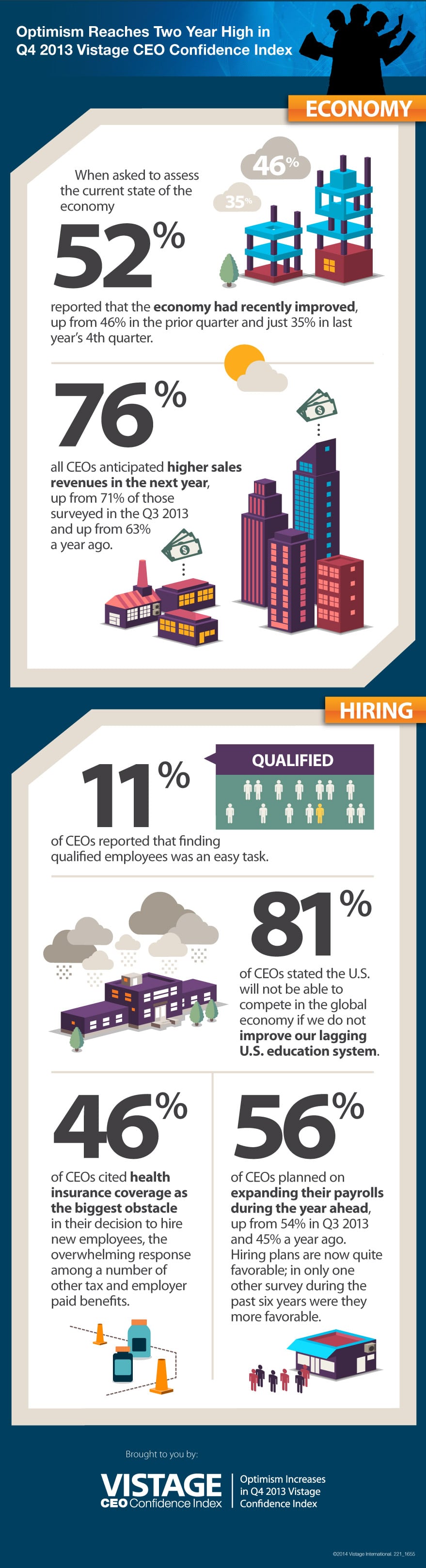
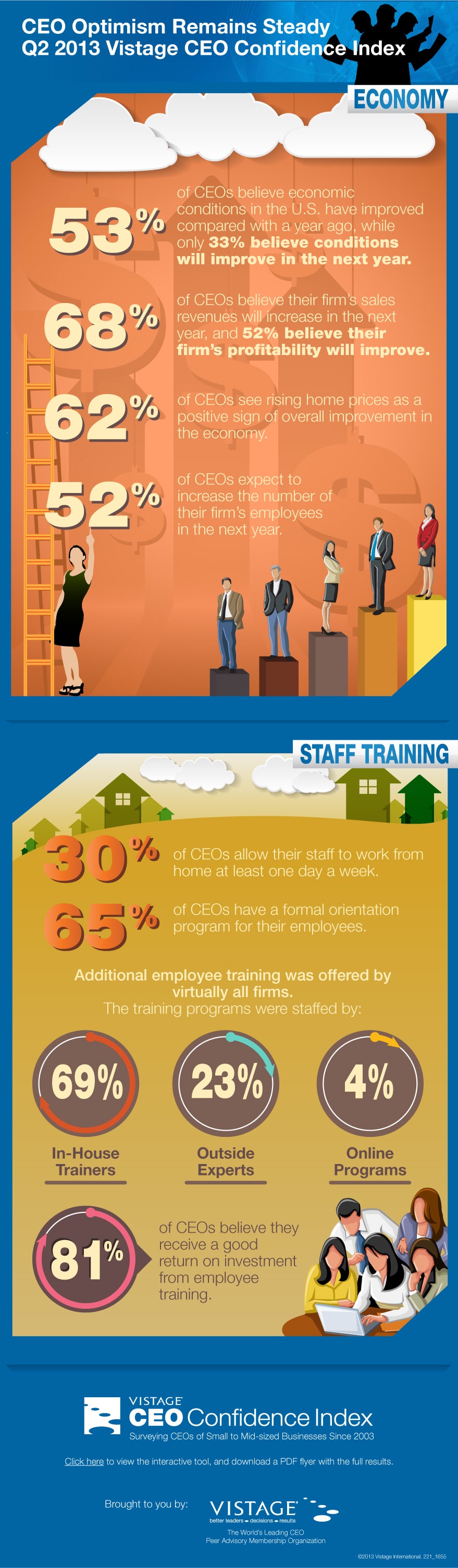
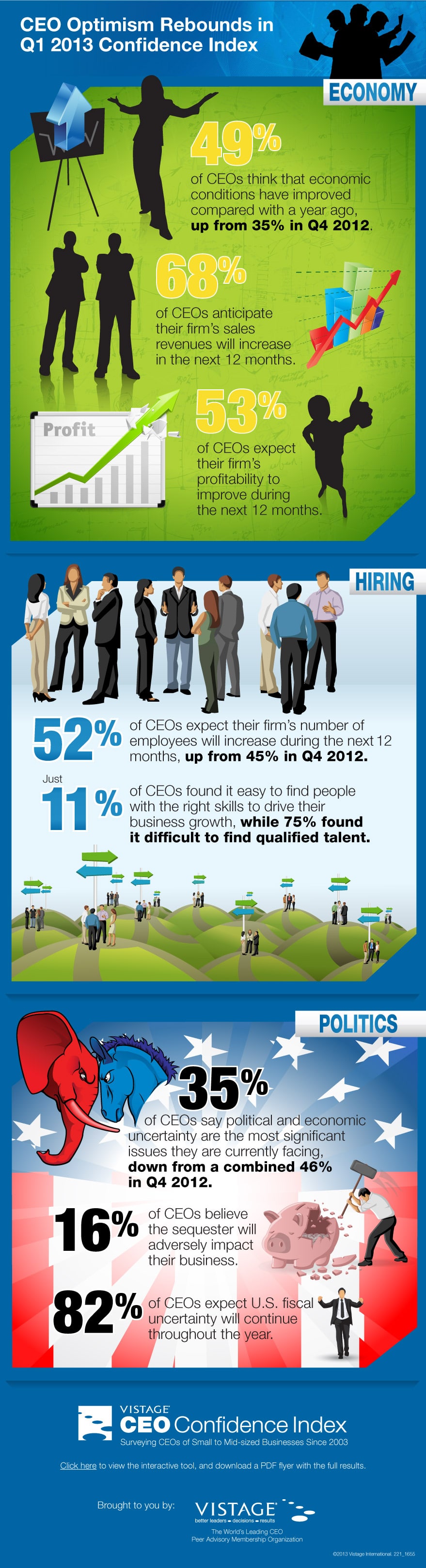
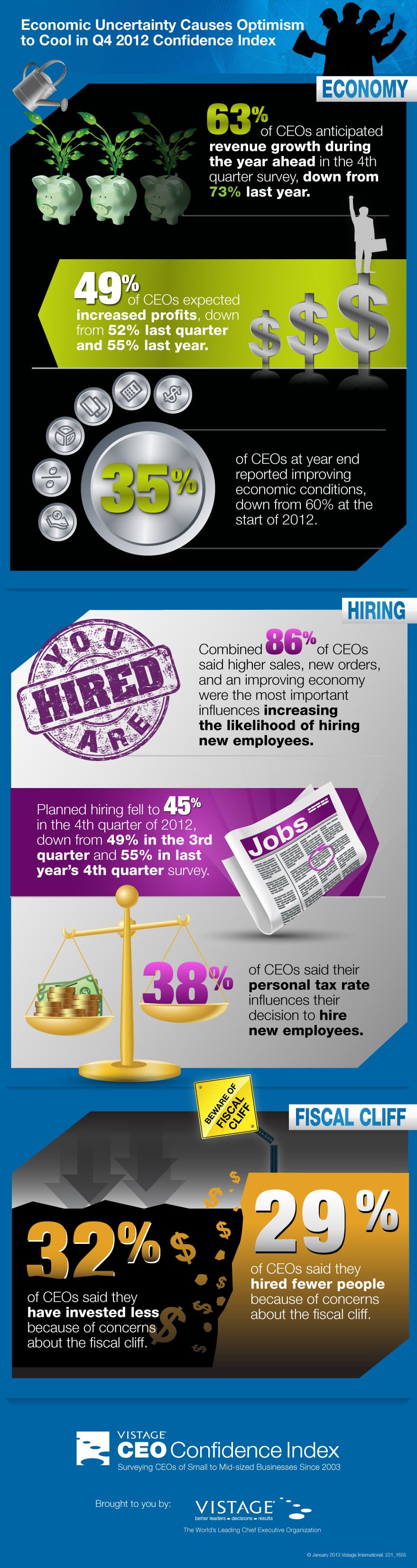
Vistage CEO Confidence Index - Optimism at a Two Year High among Small and Mid-sized CEOs

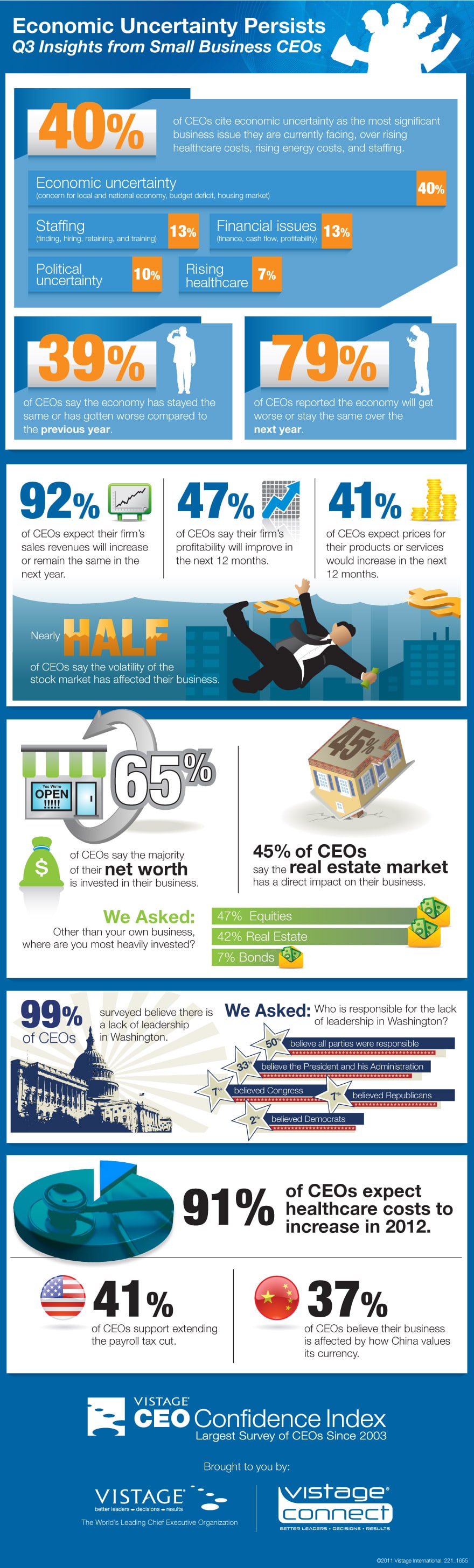
Vistage CEO Confidence Index

Optimism at a Two Year High among Small and Mid-sized CEOs, According to New Survey from Vistage

CI-graph-q3-280

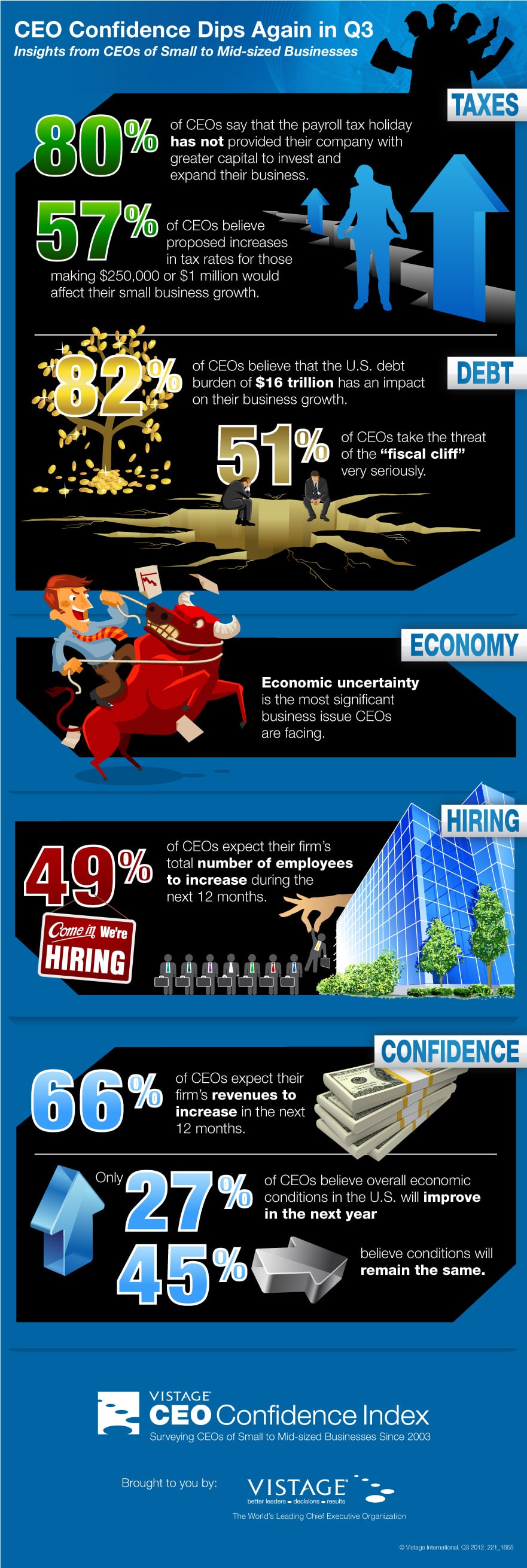
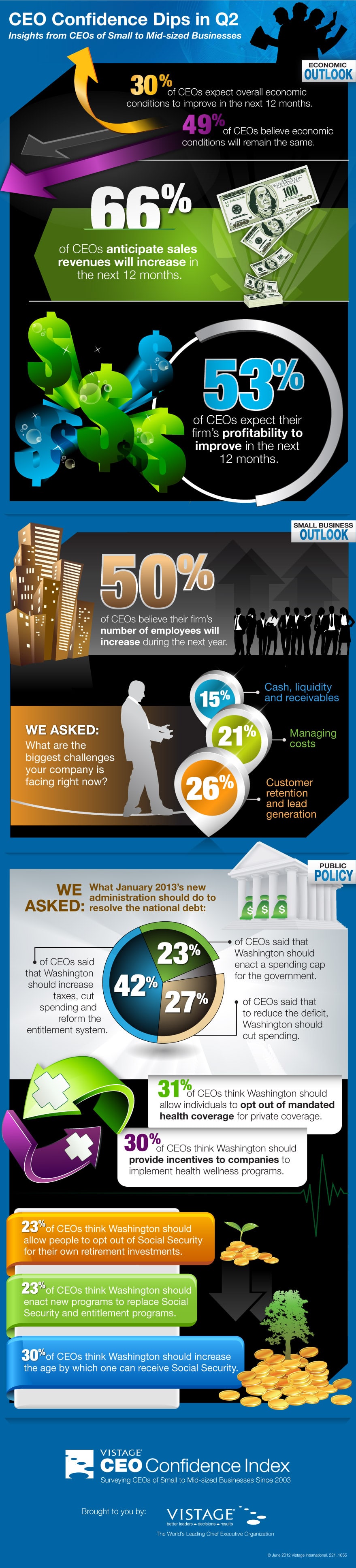
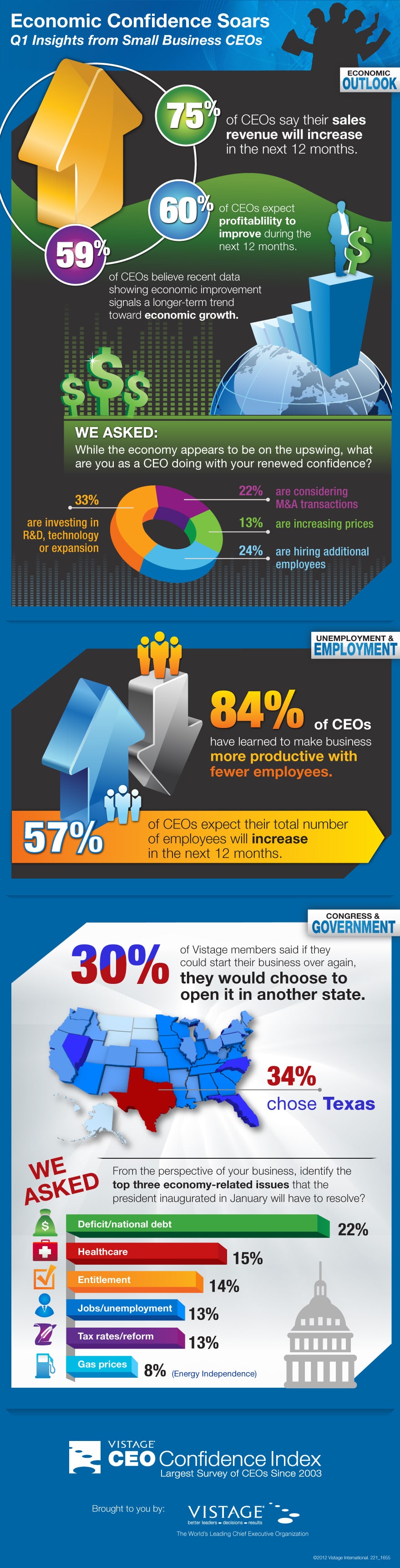
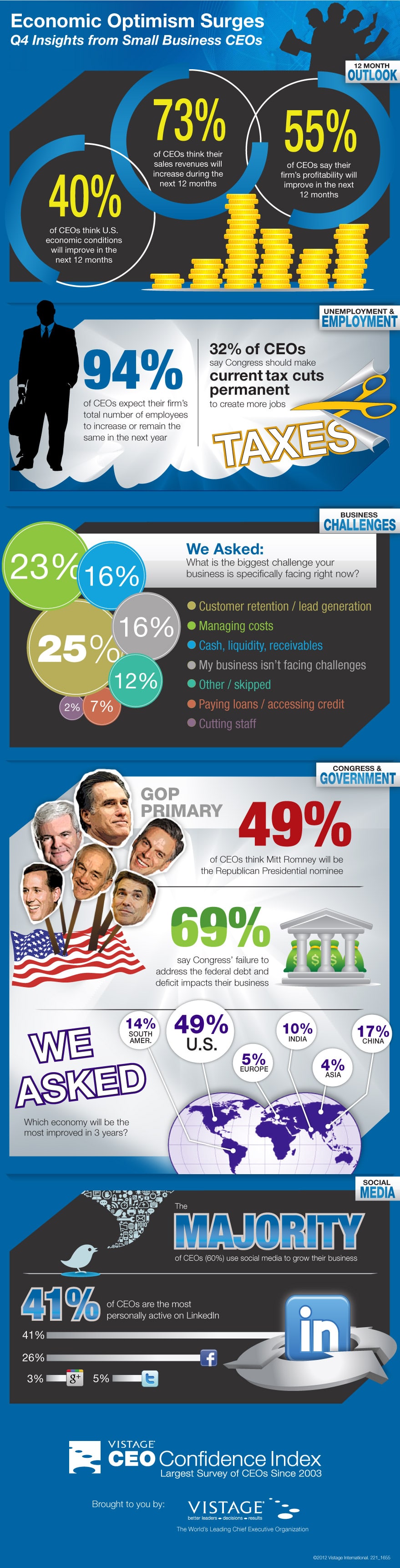
SAN DIEGO (October 1, 2014) – Optimism among small and mid-sized business leaders is at a reported two year high, according to the Vistage CEO Confidence Index, the largest survey of chief executives from small and medium-sized businesses in the United States. And this vote of confidence from these business leaders reveals a positive trend in the U.S. economy as a whole. 

The Voice of Main Street Business

History
The Vistage CEO Confidence Index is a compilation of responses from more than 2,000 CEOs of small- to mid-sized companies. The Vistage CEO Confidence Index began in Q1 2003 and is the largest and only comprehensive report of small and mid-size CEO opinions and projections.

U.S. small and mid-sized businesses represent the most vital component of the nation’s economy. This sector creates 75% of all new jobs and generates 50% of all national revenue. The opinions of these business leaders provide a clear snapshot of current economic, market and industry trends and demonstrate their plans for growth over the next 12 months. These insights provide a leading indicator for employment, capital expenditure, sales, and revenue and profit trends.

When It Began
The Vistage CEO Confidence Index began in Q2 2003 when 1041 Vistage member CEOs responded to a Vistage survey, creating the baseline against which the index is measured. Since then, the Index has grown into the largest survey of chief executives from small and medium-sized businesses in the United States. Each quarter, CEOs are asked the same set of 9 questions based on the overall economy, as well as 5-7 questions relating to current economic issues. The set questions become the components of the Confidence Index score.

How is the Confidence Index Calculated?
All component questions are scored as the percent giving favorable replies minus the percent unfavorable plus 100. The Vistage Confidence Index is the sum of the components calculated as a percentage of the level recorded in the 2nd quarter 2003 survey. The results are analyzed by Dr. Richard Curtin, the chief analyst at the University of Michigan, Ann Arbor.

About Dr. Curtin

Dr. Richard Curtin- Vistage CEO Confidence IndexDr. Richard Curtin is a Research Professor and the Director of the Surveys of Consumers at the University of Michigan since 1976.

Professor Curtin’s monthly report on consumer confidence is one of the most closely followed economic indicators, with findings from his research extensively reported in the media. His research is widely used by businesses and financial institutions as well as by federal agencies responsible for monetary and fiscal policies. Data from the Surveys of Consumers is an official component of the Index of Leading Economic Indicators.

Through frequent presentations and published articles, Professor Curtin has reported on his research in behavioral economics, including the theory and measurement of expectations, consumer saving and spending behavior, household income and wealth, reactions to changing economic opportunities, and public policy preferences. Professor Curtin has consulted with hundreds of corporations on issues related to future trends in consumer purchases.

Monday, February 3, 2014

The Most Valuable Lesson I've Learned as a CEO


I was recently invited to join the CEO of a Silicon Valley tech company for a fireside chat at his annual global leadership summit. He's been interviewing other CEOs at the event for years as he and his team value hearing the perspectives, experiences, and best practices of other companies. He did a great job moderating and I truly enjoyed the event.

One of the questions he asked is one I get frequently: What's the most valuable lesson you've learned as CEO?

My answer was simple: Don't leave the pitcher in the game for too long.

For those less familiar with baseball, some explanation may be necessary. Picture the following:

It's the eighth inning of a game. A star pitcher is on the mound and has been pitching well. His team is up by a few runs. The bullpen is well rested and ready for action should he start to tire. The inning opens and the pitcher gets the first out, continuing his already strong performance. Then it begins.

The opposing team gets a hit.

And then another.

It's increasingly clear the pitcher's arm is tiring and his velocity is wavering. His manager, recognizing the situation, approaches the mound and asks how he's feeling. The pitcher replies exactly as you'd imagine (remember he's a star pitcher; he didn't get that way for lack of confidence):

"Skip, you've got nothing to worry about. I misplaced that first pitch and that last hitter got lucky. I've got this."

The manager returns to the dugout and watches in disbelief as the opposing team eventually ties the game and goes on to win in extra innings. For baseball fans, you may be nodding in agreement with how familiar this scenario is. (To Red Sox fans, my apologies for reminding you of this.)

I've seen the same scenario play out countless times, both directly and indirectly. However, I'm not referring to baseball. I'm talking about business.

Leaving a member of your team in a key role when it's no longer the right fit is one of the most common -- and costly -- mistakes a manager can make. The good news is that with practice and experience it's also one of the most avoidable.

Here are a few of the lessons I've learned to help address the issue:

1. In nearly 20 years of doing business, no one has ever approached me and said they couldn't do their job. Not once. 

No matter how challenging the role, people will be inclined to believe they can get it done. It's human nature, equal parts ego and optimism. Simply put, we're programmed to finish what we've started. Admitting that we can't do it is just too hard for most of us, a particularly acute trait among overachievers.

As a result, just like the star pitcher in the late innings of an important game, most individuals are not in a position to objectively evaluate their own performance. That's where management comes in.

As a manager it's up to you to identify the potential performance issue and act accordingly. Perhaps that will result in leaving that individual in the role, perhaps not. Regardless, it's ultimately your responsibility, not theirs. The sooner you hold yourself accountable for that decision, the better for everyone involved.

2. If you have to ask whether or not someone is up to the task, you already know the answer
 
Deep down, we all know how to identify performance issues as soon as we see them. The challenge is that given the consequences, many of us may not want to admit the issues exist. In turn, we may end up asking others for their opinion in the hope we've somehow got it wrong, which may only serve to further muddy the waters.

There is a simple rule of thumb here: If you have to ask yourself (or others) whether or not someone on your team is doing their job, you likely already know the answer. They're not.
The key to managing out under performers or poor cultural fits is not so much about identifying the fact they're falling short of expectations. If we're being honest with ourselves, we're already well aware of the problem. The key is in determining whether or not that person will ever be capable of doing the job. Which brings us to #3...

3. Create a timetable

Once you've recognized a performance issue with a member of the team, more often than not, the natural inclination is to rationalize it away. This is typically a byproduct of fear: Fear of how difficult it will be to replace the individual, fear of hurting them, fear of how their team will react, etc. That fear will inevitably lead to sub-optimal decisions that have the potential to do far more harm than the fear itself.

The solution is to create a timetable as soon as you've recognized an issue exists, i.e. how long will you give the situation until making the final determination that the person can't perform in the role?

Bear in mind, there is not a single, uniform answer for this. It all depends on the individual and the situation. Whether one month, three months, six months, or a year, make sure you are doing everything possible within the allotted time to help the individual clear the bar. Be transparent about your timing and expectations. Let them know the specific measures you'll be putting into place to assist them, e.g. coaching, access to specific learning and development tools, reduced workload, organizational changes, etc. Hopefully, the changes work and that individual begins to flourish over time.

However, if it's still not enough, do everything within your power to transition them out of the role compassionately.

4. Managing compassionately should not be confused with avoiding difficult decisions

Whenever talking about this subject, inevitably the question arises: How can you transition someone out of their role compassionately? Given how much it's going to hurt them, isn't that an inherent contradiction?

My response is that the least compassionate thing you can do in this situation is leave someone incapable of doing their job in that role for too long.

Think about the last time you saw someone on your team that was struggling: The slumped shoulders, the increasingly hushed tone of their voice, their overall lack of presence during important discussions. It's all a byproduct of the fact they know consciously or unconsciously that they aren't getting the job done. Subsequently, it's draining their self-confidence, and it's only going to get worse over time. Their inability to perform is hurting them, their team, the company, and perhaps worst of all, they are bringing that energy home to their families.

The most compassionate thing you can do in this situation is to alleviate their suffering by transitioning them out of the role as gracefully and constructively as possible.

One person I know who went through this kind of transition returned several months later and said as much as they fought to hold onto their job, and as fearful as they were about the repercussions, moving on was one of the best things that had ever happened to them, both professionally and personally.

One final thought on the subject: After responding to the question about the most valuable lesson I've learned as a CEO, the moderator of the fireside chat added a somewhat unexpected observation. He said that while the other interviewees had not used the same baseball metaphor, 100% of the CEOs he's interviewed thus far responded with the same answer. 

Hope you can benefit from the lessons we've learned. 
Posted by:Jeff Weiner

Thursday, May 2, 2013

Your Optimism Might Be Stifling Your Team

By: Liz Wiseman

I admit that I'm prone to an optimistic outlook, a belief that most problems can be tackled with hard work and the right mindset. I've read the research that indicates that positive thinkers tend to do better in school, work and life. Perhaps I even assumed that optimism was infectious and that people wanted to work with a confident, hopeful leader. In the true spirit of optimism, how could this possibly go wrong?

Then I found out from a colleague that he didn't find my optimism nearly as reassuring as I did. We were in the middle of a high-stakes research project with a small window of opportunity to write an article for a prominent academic publication. To pull this off, we needed to complete a complex analysis, do a round of additional research, and actually write the article, all while working on several other projects and operating on a thin budget. 

To me, this seemed like a feasible, interesting challenge, and I enthusiastically dove in. Then at one critical meeting, a more junior colleague turned to me and said, "Liz, I need you to stop saying that!" 

"Saying what?" I asked. 

"Saying that thing you always say — 'How hard can it be?'" I looked puzzled. He explained, "You say that all the time. 'How hard can it be? We can do this. After all, how hard can it be?'"
I recognized what he was saying and began to explain my logic: While I was working for Oracle Corporation, a small but rapidly growing company, I had been thrown into management at the tender age of 24 and was told that I was now in charge of training for the entire company and was tasked with building Oracle University and making it work in globally. I learned to say to myself, "We can do this. After all, how hard can it really be?" Now, I explained how this growth mindset had worked beautifully for me and many of my colleagues over the years. Yet steadfast, my colleague reiterated, "Yes, but that is what I need you to stop saying." 

"But why?" I probed. 

He paused and said, "Because what we are doing is actually really hard, and I need you to acknowledge that."

He wasn't opposed to the idea that our enormous task was doable; he simply wanted me to acknowledge the reality of the challenge and recognize his struggle. He didn't want me glossing over the challenge with my coat of optimism. So I did admit, "Yes, what we are doing is hard. It is really, really difficult." I then assured him that I would do my best to stop saying that thing.

Meanwhile, in the back of my mind I told myself "Sure, I can stop saying that. After all, how hard can it be?" 

Is it possible that a can-do attitude that worked so well for you as an individual contributor may actually work against you as a leader? When you play the role of the optimist, you may undervalue the struggle the team is experiencing or their hard-fought learning and work (or give the impression that you do). Your staff may wonder if you have lost your tether to reality. And, when a leader seldom focuses on the problems, it leaves more junior managers to worry about those risks. In fact, by being too optimistic, you may actually be putting your employees in the role of having to play the "sensible pessimist." Or worse, you might be sending a message that mistakes and failure are not an option because, after all, "How hard can it be?" And yet wise managers know that mistakes are inevitable, and that failure is just the price of creativity. 

Having coached many executives, I know that senior leadership ranks are filled with glass-half-full types (in fact, one might need to be an optimist to cope with the inherent pressure of these positions). Consider how Nike, Inc.'s chief of global design, John Hoke, sparked a transformation in his organization once he realized the restrictive impact his and his management team's optimism was generating. John gathered his senior leaders for a week-long offsite to explore new thinking in design and how leaders can multiply the talent inside their organization, which I helped facilitate. As I described the profile of the optimistic, creative, energetic leader, John and his team quickly recognized their own reflection and were curious how they might be inadvertently diminishing capability and ingenuity in others. John asked that we pause our agenda to better understand how his own hopeful style of leadership might actually be causing some angst. His team explained the extraordinary pressure they felt to deliver flawless design, every time. With the London Olympics around the corner and a brand promise to sustain, the group insisted that there simply was no room to fail. 

With John's encouragement, we decided to define a space for experimentation. We rapidly laid out their various work scenarios into two buckets: One where failure was OK and the other where success had to be assured. The group debated each until they agreed on every scenario. Within an hour, they had created a playground — a safe space for their teams to struggle and potentially fail without harming their stakeholders or their business. This thinking rippled across Nike's design community and sparked leaders like Angela Snow, VP of creative operations and Casey Lehner, senior director of global design operations, to introduce the "risk and iterate" performance goal that encouraged each team member to identify something they would take a risk with and then iterate solutions throughout the year. This effort legitimized the possibility of failure and created safety for designers to tackle the scary problems. 

John Hoke and his management team didn't lower their aspirations or become less optimistic about the capabilities of their team. But, by acknowledging the downside and recognizing the messy, iterative path of innovation, they liberated their team to go bigger and reach further. 

Go ahead and be optimistic. But first, be sure to acknowledge the downside so your team is free to explore the upside.


Liz Wiseman

Liz Wiseman

Liz Wiseman is president of The Wiseman Group, a management research and development center in Silicon Valley and author of Multipliers: How the Best Leaders Make Everyone Smarter.